


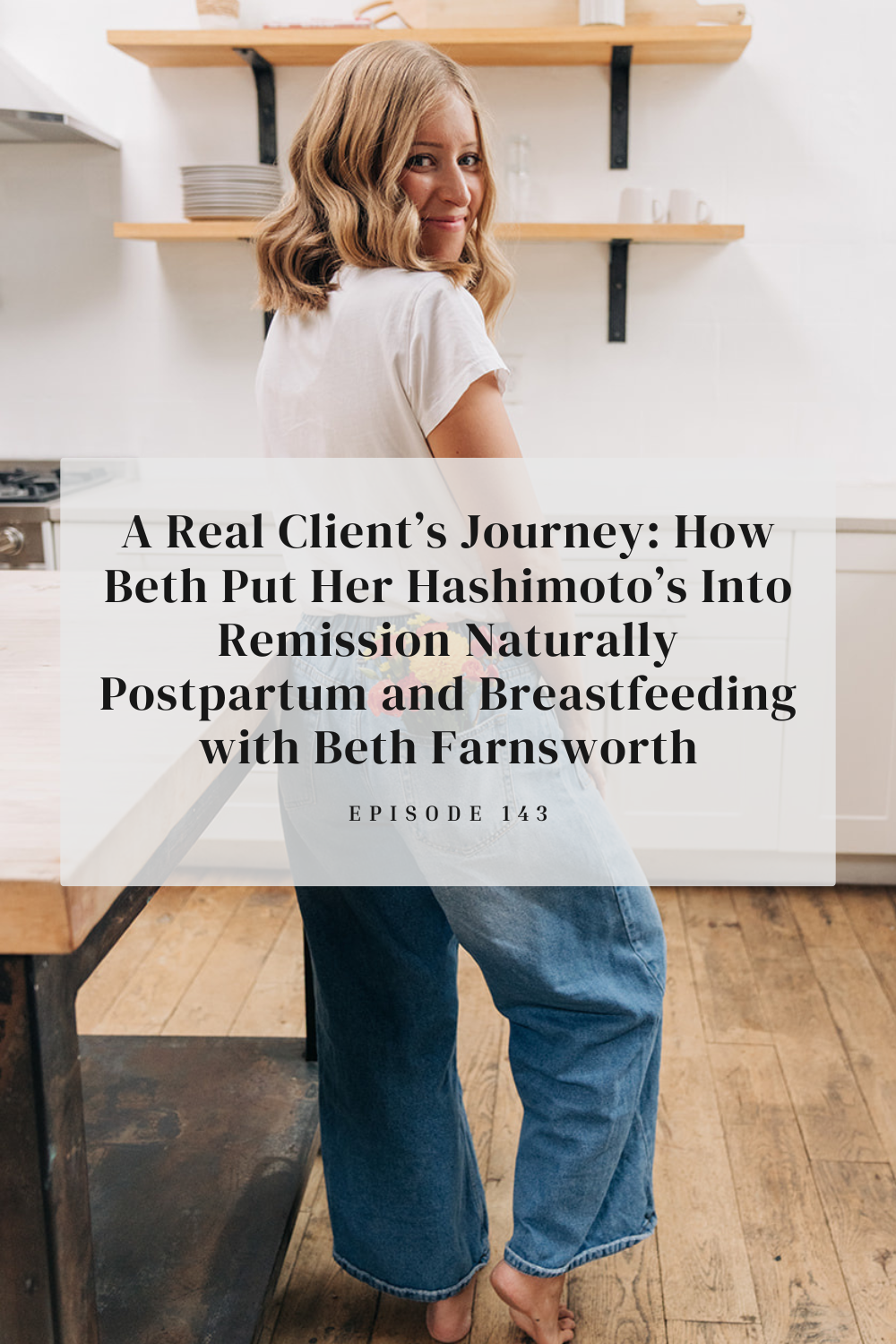
This episode is a powerful reminder that healing is possible when you address the body as a whole. Beth's story demonstrates how personalized nutrition, functional testing, and root-cause care can help women move beyond simply managing symptoms toward rebuilding their health from the inside out.
Save your seat inside The Confident Mama Masterclass → Join the Workshop here
Apply for my coaching program and get access to HTMA testing here → Apply Today
Use my link for JustIngredients to get 10% off (or enter code: thewellnourishedmama) → Shop JustIngredients here
Brooke Harmer: And yes, um I'm wearing my pajama shirt right now because nothing else fits. So, we don't have to worry about video for all of this. Okay, let me make sure. I don't know if my microphone is actually Nope. I need to change the microphone. Okay. Does that sound different than it used to? Does that sound better? Okay,
Beth Farnsworth: Yep.
Brooke Harmer: awesome. Fix the microphone. Okay, you ready?
Beth Farnsworth: Yep.
Brooke Harmer: Awesome. Hey Beth, thank you so much for joining us today. We're excited to have you here.
Beth Farnsworth: I'm so excited to chat with you,
Brooke Harmer: For those of you who don't know,
Beth Farnsworth: Brooke.
Brooke Harmer: Beth is one of my clients who has graduated from the Healing Mama program and she has the most incredible story. And so we just want to take you along Beth's journey today, let you hear from her firsthand where she used to be, what her experience was like working with my team and I, and where she's at now, just to give you an idea of what's possible for you, and um really help you see that not all is lost and we can help you reach your goals, whatever those might be.
Brooke Harmer: So Beth, before we jump into that, can you just give us like a quick lowdown about you? How many kids do you have? Where do you live? Talk to us about your family
Beth Farnsworth: I currently live in Denver, Colorado,
Brooke Harmer: life.
Beth Farnsworth: and I have three kids. I have a 4-year-old, a 2-year-old, well, 2 and 1/ halfyear-old, and a one-year-old. So, it my house is a circus, and it's so fun, but um also crazy.
Brooke Harmer: Yeah, you're basically right there with me. I have almost five, almost three, and almost one and a half. So, I'm just like a tiny step in front of you with all those kids. I love it. Um, okay. So,
Beth Farnsworth: Yes.
Brooke Harmer: let's start at the beginning. I guess maybe a little less than a year ago. I think it was like right around the holidays that we started talking. So, let's flash back to like October, November of 2025 last year. What was your dayto-day like?
Brooke Harmer: How were you feeling? What was postpartum like? You were nearly postpartum with your third baby. What wasn't working for
Beth Farnsworth: So, I was 4 months postpartum and with my second baby,
Brooke Harmer: you?
Beth Farnsworth: I had had a little bit of postpartum thyroiditis, but it went away pretty quickly. I didn't have to do anything to manage it. But this time around, I was exhausted. I remember just laying on the couch one day. I couldn't get off the couch to make my kids lunch. I was so tired. My body just hurt. And I was like, "Okay, something is wrong." And with some of my health knowledge, I was like, "Okay, I bet you it is my thyroid." Um, but I just remember like just waiting for my husband to get home and I had called him actually and be like I can't make the kids lunch. I am exhausted. Please come home. And it was like that every day. Like I was just dragging waiting for lunchtime because as soon as we got through lunch I could put the kids down for a nap and then I could sleep or just lay there and not have to do anything.
Brooke Harmer: That's absolutely insane. And I'm sure from multiple people, whether it was your doctor or family or friends, I'm sure you heard, "But Beth, you just had a baby. Of course, you're tired. But Beth, you're breastfeeding. But Beth, you're not sleeping through the night." How did you know that what you were feeling wasn't really like normal
Beth Farnsworth: Yeah, that is a common thing that was said like,
Brooke Harmer: postpartum?
Beth Farnsworth: "Oh, you just had a baby. You're postpartum. I had had a C-section this time, so it was a little different." But I knew that just because I was a mom and just because I was postpartum didn't mean I had to be ridden to the couch and exhausted and ragy. All those things I knew that wasn't how it had to be. There was something going on that there was something going on that was prohibiting me from feeling better and being the mom that I really could be.
Brooke Harmer: And I'm sure that because this was your third time around, you're like, "Okay, you know, this is kind of what it's been the last two times, and it's a little bit different this time." But even for those first time moms listening,
Brooke Harmer: I love what you said where you're like, "Just because I'm a mom doesn't mean I deserve to feel this way." Like,
Beth Farnsworth: Of
Brooke Harmer: why should we just blame it on just having a baby? Like who wants to feel that way,
Beth Farnsworth: course. Yeah. Just because you had a baby, especially for those first-time moms,
Brooke Harmer: right?
Beth Farnsworth: um that doesn't mean that different symptoms are normal. Um I am a pre-postnatal trainer and I focus on pelvic health and a common thing is like, "Oh, you're a mom. you just had a baby, it's normal to pee your pants or it's normal to leak. And that's another thing where it's like just because you're a mom doesn't mean you have to deal with a bunch of different things that society deems to be
Brooke Harmer: Yeah. So, talk us through some of those other symptoms.
Beth Farnsworth: normal.
Brooke Harmer: You mentioned the I'm going to say crippling. Like that sounds crippling to me. The fact that like you were having a hard time making your kids lunch.
Brooke Harmer: So, besides the crippling fatigue, what were some of the other symptoms that clued you into I need to go get blood work done. I need to investigate.
Beth Farnsworth: Yeah, besides the crippling exhaustion, I was gaining weight. And after I mean, this was my third baby. I've been around the block a it. I was like, "This isn't normal. Normally, I lose the weight pretty easily. I'm breastfeeding." Um, but the fact that I was gaining weight, I'm like, "Okay, something is up." Um, I had terrible brain fog. I wasn't sleeping well. I had awful GI symptoms. I was just miserable. and kind of got to a breaking point where I was sick and tired of feeling sick and
Brooke Harmer: seriously.
Beth Farnsworth: tired.
Brooke Harmer: Yeah, I remember I think bloating was one of your major ones where you're just like I am just not okay the bloating.
Beth Farnsworth: Yes.
Brooke Harmer: And then what about some of your other mental health symptoms? Did you have anything going on with your mental health too?
Beth Farnsworth: Yeah. I was just more depressed than normal. And it I knew it wasn't just like postpartum blues or postpartum um symptoms. And I think a lot of it was it I think a lot of it came from all the other symptoms that were just exhausting my body. And another um symptom was I with both my first two kids, I got my period back at 3 months postpartum and we were working together like closer to 5 6 months postpartum and I'm like I still haven't gotten it back. Like that's not normal for me. And so I just had a lot of those symptoms and signs that something wasn't going on correctly with my
Brooke Harmer: I love that you bring up your cycle because I think most moms are like,
Beth Farnsworth: body.
Brooke Harmer: I don't want my period back if I'm breastfeeding. Like, let's push that out as long as we can. And you know, for what it's worth, maybe we don't want that. But I like that you pointed out that's not normal for me.
Brooke Harmer: I know what my body usually does. And even though it might not be like the best thing in the whole world, I don't know. But you knew, you're like, "Hey, my period is a sign of health. It's a vital sign. And even though I'm breastfeeding, it's not coming back. We need to figure out what's going
Beth Farnsworth: Yeah,
Brooke Harmer: on.
Beth Farnsworth: I was definitely some moments like grateful that I wasn't back, but also I was like, "This isn't normal." And I want to have that sign of health and that everything's good. So, it was definitely like a mixed feelings, but definitely something I wanted to get to the bottom of.
Brooke Harmer: Yes, absolutely. Um, I pulled up your client notes to see if we missed any symptoms. You also mentioned headaches. That was one of the ones that we were tracking every month.
Beth Farnsworth: How How could I forget that? They were awful.
Brooke Harmer: your headaches and your acid reflux and
Beth Farnsworth: Yes.
Brooke Harmer: cravings.
Beth Farnsworth: Uhhuh.
Brooke Harmer: And then we grouped mental health together. We grouped your GI symptoms together and then you did mention sleep. I want to ask you about that really quick because I also hear a lot of moms say, "Well, yeah, you're not sleeping well. Like, baby doesn't sleep through the night." But you and I know that there's like some nuance to that. So, when you say, "I wasn't sleeping well." What does that mean for you? And how did you know that it wasn't just you're getting intermittent sleep?
Beth Farnsworth: I was just not getting restful sleep. All three of my kids, I mean, my third baby still doesn't sleep through the night, but they never slept through the night until after they were a year old. And so, I knew that there was a difference. Um, even if you're feeding them all night long, you still get those little restful periods and before I was just like a train wreck. I was exhausted and the night did nothing for me. I'd go to bed exhausted and then I'd wake up and just feel defeated.
Beth Farnsworth: I'm like, how am I supposed to do anything? Like just the thought of like having to make breakfast for my kids or change my kids diapers or like get them dressed. There are so many days they stayed in jammies all day long because I was just exhausted from the day before and then not getting any restful sleep the night
Brooke Harmer: Yes. Amen.
Beth Farnsworth: before.
Brooke Harmer: that there is such a difference where you can still get broken sleep and still feel I don't want to say well rested but you can feel like you actually got some restoration during the times that you were asleep where you don't feel like you got hit by a train when you woke up and you do have energy to get up and do the things in the morning. So I love that you point that out because so many moms and providers are so quick to say, "Well, yeah, you're not sleeping well. you've got little kids and you're like, "Well, I mean, kind of." And it's really hard to quantify sometimes when everyone else is so quick to just brush
Brooke Harmer: it off. I love that you were just like, "No, like even if people tell me this is normal, I don't want this to be my normal, I don't want to feel this way, and I want to see if there's something I can do about it." So tell us,
Beth Farnsworth: Exactly.
Brooke Harmer: Beth, what did you do about it? What were your next steps after you kind of put this picture together of I am not okay and I am done not being
Beth Farnsworth: So, I am a very fix it myself person.
Brooke Harmer: okay.
Beth Farnsworth: Like, I will go and get all the knowledge out there that I can and do it myself. I'm very thrifty and frugal. And so, up to that point, I had done all those things. I was trying to work out when I had the energy. I was trying to get sleep at night. I was prioritizing protein. I was drinking electrolytes. All these things. and there was just a piece missing. And so I had followed Brooke for a while and I decided, you know what, let's just hop on a call.
Beth Farnsworth: And in my mind, I was like, "Okay, like if I'm willing to pay for help, if it's" and I just kind of had like imaginary numbers in my brain and I was like, "Okay, well, if it's like around this much, then like maybe I'll just work with her." And as we were talking, um, my husband was kind of in the background listening to our conversation.
Brooke Harmer: I remember
Beth Farnsworth: And yes,
Brooke Harmer: that.
Beth Farnsworth: and after talking with Brooke, I there were just so many things that like fit together and I was like, this is what it I need. I need this outside person who can see more of the whole picture and help me get down to the bottom of what's going on here. And I was like hesitant for the financial obligation, but my husband was like, "You spend money on your kids. Like you would do anything to help your kids and you are miserable right now." And he's like, "It is worth the money. Like spend the money with Brooke and I want you back." Cuz I
Beth Farnsworth: was not the Beth that I was before. And my husband saw a lot of that which was very helpful to hear an outside perspective of my husband saying, "No, you get headaches all the time. No, you're not sleeping. No, you're exhausted." So, um,
Brooke Harmer: And remind me,
Beth Farnsworth: yeah.
Brooke Harmer: you had just gotten a diagnosis either like right before we hopped on a call or right after or like right around the time that we started talking about working together. What had you learned from your doctor that also gave you information of oh actually like I might need to work with
Beth Farnsworth: Yeah. So, I had a feeling it was something with my thyroid and so I messaged my
Brooke Harmer: Somebody.
Beth Farnsworth: doctor, got some blood blood got some blood labs done and she was like, "Oh, yep. Your different thyroid labs are high or low." um leaning towards hypothyroidism. So here, take this thyroid medicine. Um I'll write you a prescription for levothyroxine and we'll like chat in a month.
Beth Farnsworth: And I did not want to go on the thyroid medication. And so I was like, well, something's got to change. So that's where Brooke came into play.
Brooke Harmer: Yeah. So you and remind me did they did your doctor say hypothyroidism or did they say Hashimoto's because when I saw your blood work I was like yeah that's Hashimoto's but is that what your doctor had
Beth Farnsworth: I think she had stated hypothyroidism first and then kind
Brooke Harmer: said
Beth Farnsworth: of mentioned like, oh, it could be Hashimoto's, but they weren't willing to do the um thyroid antibbody test. I had to request that one done um because my doctor was like, "Well, it doesn't matter what that test tells us. And I'm like, well, it'll tell us if it's a um an autoimmune condition and we have to know what's going on to be able to figure it out and treat it.
Brooke Harmer: Yeah. So, when you came to me,
Beth Farnsworth: So,
Brooke Harmer: you had gotten a diagnosis of hypothyroidism. Your doctor wanted to put you on medication and you're like, "No, I don't want to do that." For those listening who are familiar with Thyroid Labs or maybe find yourself
Brooke Harmer: in Beth's shoes right now, when Beth and I started working together, Beth, if you don't mind, can I share your your numbers from your thyroid panel?
Beth Farnsworth: of
Brooke Harmer: Okay. So, um, in January,
Beth Farnsworth: course.
Brooke Harmer: so this was like right after we started working together, your TSH was 13.3, which is high. Um, so that's classic hypothyroidism. T4 was low, T3 was low, and then your antibodies came back at 40.9. Um, and for most providers, they usually cut off around like 34, like if you're less than 34, they're like, "Eh, you're fine." And so, you were like just barely over that threshold. And it's so interesting to me that they're like, "Well, it could be Hashimoto's." And we get your blood work back and I'm like, "Beth, you have antibodies present." Like, I don't know why it's a question. So when we like actually started doing our work, we weren't just focusing on your thyroid. We were focusing on the autoimmune side as well because you did get those antibodies tested.
Brooke Harmer: We did get the results back and it came back positive for
Beth Farnsworth: Yeah.
Brooke Harmer: antibodies.
Beth Farnsworth: So we like having that knowledge guided us to know what to do. Um whereas doctors just like briefly glance at your labs and then are very quick to prescribe this and that.
Brooke Harmer: Yeah. Okay. So, I think we started working together. Was it right around Christmas?
Beth Farnsworth: It was the week before
Brooke Harmer: Yeah, it was the week before Christmas, so mind you,
Beth Farnsworth: Christmas.
Brooke Harmer: this is like right in the middle of holiday shopping and like everyone being off of school and work and all these things. And Beth's like, "No, we're starting now." Like, I'm not going to wait till the holidays are over. We're starting now. So, we started right before Christmas and we got the blood labs ordered. We got your HTMA test ordered and we started off with the basics. Like before we even got any test results back, we were already diving into very specific things to try and help you get out of that survival mode and then prepare your body for all the really intricate detailed work that we were going to do once we got your test results back.
Brooke Harmer: Do you remember what some of those really basic things were that we started
Beth Farnsworth: Yeah,
Brooke Harmer: with?
Beth Farnsworth: we did um like a lower histamine diet and so I limited um some higher histamine foods and then I really worked on my circadian rhythm.
Brooke Harmer: Yeah. Yes, that was a big one for you. Tell us about circadian rhythm and just like everything that comes with that. How did that help
Beth Farnsworth: I that circadium rhythm was probably my favorite thing and
Brooke Harmer: you?
Beth Farnsworth: one of the most helpful things that we worked on together. I so especially after like not sleeping well at night, feeding a baby throughout the night, I loved being able to just open my curtains and open the blinds and let the sunlight just shine on me, wake me up, refresh me. And then I was also very conscious about not using overhead lighting. And so we have like a little candle in our bathroom. So I wouldn't turn the bathroom light on right away. I wouldn't turn any of the lights on downstairs.
Beth Farnsworth: We would turn a lamp on. I'd open the curtains. And that first week we were actually at a cabin with my husband's family for Christmas. And I remember it was getting late at night and they're turning just all the overhead lights on. And I you could see like I looked like a deer in the headlights. I was like like we got to turn these lights off. But I wasn't being dramatic about it. So my husband just kind of noticed and he's like, "Okay, well, let's turn these lights off and use this lamp instead." And so I was
Brooke Harmer: Your husband is my favorite.
Beth Farnsworth: very,
Brooke Harmer: He's so
Beth Farnsworth: yes, he has been so supportive through this.
Brooke Harmer: awesome.
Beth Farnsworth: Um, but I just have loved making that a priority of not using the overhead lights, trying not to use my phone um once it gets dark or first thing in the morning. And it's really like romanticized our life. Like we have all these lamps on or candles and they're not harsh and bright.
Beth Farnsworth: And I've really done it with my kids too. So like I'd bring the baby to the window or they would like go to turn on the kitchen light in the morning and we'd be like, "No, don't turn it on." Like if the sun is out, the lights are off.
Brooke Harmer: Yep. I always tell my kids, "Mr. Sun is awake. We don't need any lights in the house." Um,
Beth Farnsworth: Yes.
Brooke Harmer: and didn't you guys actually do some candle light dinners every once in a
Beth Farnsworth: Yes. My kids loved those, too.
Brooke Harmer: while?
Beth Farnsworth: And it was a nice little bribe like, "Okay, if you eat your if you eat your dinner, you can blow the candle out
Brooke Harmer: Oh, that's so cute. I love that.
Beth Farnsworth: after
Brooke Harmer: And mind you, remember mama Beth started this like in the dead of winter. Like this was after Christmas, beginning of the new year when like this is the least amount of light that's outside and you still were so strict about your circadian rhythm.
Brooke Harmer: How quickly did you start to see improvement in your symptoms just with these basic things? is making a couple tweaks to your diet. diet because we found that you did have some histamine overload. Um, so we made a couple changes there and then it was really circadian rhythm and that's all that we worked on for the first 6 weeks or so. How quickly were you actually seeing improvement in how you were feeling with those couple
Beth Farnsworth: I feel like it was only a couple weeks that I started to see it.
Brooke Harmer: changes?
Beth Farnsworth: I feel like getting sunlight first thing really energizes you physically, but also mentally. I feel like it was really good for my mental health. And then the anti- um histamines or the lower histamines. Um it was definitely a lot of work because a lot of the foods that I was limiting were ones that I had been eating a ton of, especially in the end of my pregnancy because I had gestational diabetes. So like eggs were one of the things we limited and that's all my blood sugar could manage for breakfast um in my third trimester.
Beth Farnsworth: And so trying to branch out and find other things that were still um nutrientdense and nourishing was definitely tricky, but once I found the things that worked, it was super easy. And I definitely noticed more energy and a lot of like the GI symptoms were starting to calm down.
Brooke Harmer: Yeah, we were seeing results really, really quickly. And I'm going to pull up a screenshot that I have saved in your folder. You sent me a message on Instagram. And at this point, we had been working together for 3 weeks, so this was kind of like near the end of January. and you're like, "I just had to message you about one of my lab tests. My TSH went down." And I was like, "Wait, what?" And so I pulled it up. Remember, your TSH was 13.3 in December. And then we got updated thyroid labs um right after we started working together to make sure we got the full thyroid panel. And your TSH had dropped 50% in 3 weeks.
Beth Farnsworth: I was so excited.
Beth Farnsworth: I had literally screenshotted my lab and I had sent it to my mom. I had sent it to my brother who's a like a laboratory scientist. Um, I was so proud of myself and I was so grateful for
Brooke Harmer: It was seriously amazing. And I want to remind the mamas listening that this was before we had gotten your
Beth Farnsworth: you.
Brooke Harmer: functional labs back. This is before we had gotten all of your blood work back. This was literally just those simple things of let's do a low histamine for a couple weeks and let's do circadian rhythm. That's all that we did and that is what happened to your TSH in 3 weeks. I just think that is so incredible and it's also such a testament to you, Beth, that You had so much faith in what we were doing and you're like, I'm just going to go 100% nose down. We are like committing and we are doing this and we're serious about it. You got your husband on board. You got your kids on board and you made those results happen.
Brooke Harmer: It was such a fun moment for us and I was like I was like calling my dad who's an ER doctor for like 25 years. I was like, "Guess what my client did? It's so flipping cool." It was like, oh, it was such a cool moment. And I am just I'm still I am so proud of you for all the hard work that you had put in and are still putting in now to see results like
Beth Farnsworth: Thank you. It was the simplest things,
Brooke Harmer: that.
Beth Farnsworth: but when I was determined and dedicated to doing those simple things, like big changes happened.
Brooke Harmer: Yeah, I love it. So, now let's move into the meat of the program and where we really started to get like really fine-tuned with our approach. So, we got your HTMA results back. This test is looking at your cellular health through the lens of nutrition and minerals. So, we really want to see um how well your cells can do their job. Our cells are in charge of DNA inscription.
Brooke Harmer: They're in charge of um creating and communicating hormones. They're in charge of using nutrients for all the things that we need. Our cells are the foundation of our health. And so with this test, we were able to get down to literally the root cause because you can't go smaller than your cells. And we saw some very incredible findings that were like, "Oh my gosh, Beth, this explains everything." Do you remember much from the results of your HTMA test?
Beth Farnsworth: I think the biggest things were my electrolyte balances and my liver.
Brooke Harmer: Yes. Yep. So, I have your HTMA pulled up. Um, you were pretty low in all of your macro minerals. So calcium, magnesium, sodium, potassium, and this is really important for your thyroid because your thyroid needs these electrolytes to have energy to do its job. And so it was kind of running on empty and sodium is also required for your thyroid to use iodine. And so your body didn't even have enough sodium to use the iodine that was present.
Brooke Harmer: We always hear about iodine and thyroid. So that was one of our major findings. Um, another one that we saw was your manganesees. Do you remember this one? Mangines is required to convert T4 to T3 and your conversion was not super great. And so right away in the HTMA test, I could point to one thing and be like, that's why your blood work shows that your T4 to T3 isn't quite working and why leveled thyroxine wouldn't have even been responsive in the first place,
Beth Farnsworth: Yes, for
Brooke Harmer: which is pretty crazy because most doctors are just like,
Beth Farnsworth: sure.
Brooke Harmer: "Hey, let's just throw this medication at you, but in your case, we got your test results back." Your body wouldn't have known what to do with the medication anyway. So, it wouldn't have been much use. So, we were able to find that out pretty quickly and build a plan around that. And the last thing that we found was that your zinc was super high. This was one of your contributors to that inflammation that we were seeing with the autoimmune response.
Brooke Harmer: Zinc is important for your immune system. But when we see it in excess in a hair test, that means that we're burning through it so fast because our immune system is in overdrive and it isn't quite sure how to regulate and so it's using zinc really, really fast. So just from your HTMA test alone, we were able to find answers for every single symptom you had. Your bloating, your cravings, your brain fog, your headaches, your fatigue, your depression, and your rage. And then we also found the root cause of all the different things that we were seeing specifically with your thyroid. Now, I want to ask you, Beth, because I just went on a little TED talk for a second. What were your thoughts when we first went over your HTMA results together? What was going through your head when I was explaining all of that to you like I did just
Beth Farnsworth: So often in my life,
Brooke Harmer: now?
Beth Farnsworth: I have had like different health things and I have labs done and they come back and they say, "Oh, they're normal. Nothing's wrong." And I'm like,
Beth Farnsworth: "Well, something is wrong because I don't feel the way I should or this isn't working how it should." And so to see something come back and be like, "Oh my goodness, this is what's going on like I'm not just making up all these symptoms or it there really is a root cause to why I feel so
Brooke Harmer: Yeah,
Beth Farnsworth: horrible.
Brooke Harmer: it I I I find that most clients describe it as kind of this light bulb moment where they're like, "Oh my gosh, like you said, I'm not crazy. Everything makes sense." And because it's all through the lens of nutrients now, we know exactly what to do with your diet. We don't have to guess about what foods are going to be helpful, what foods we need to limit. We can just like walk right in and have this exact plan. And that's exactly what we did. So, do you remember what we focused on in phase 2? What was our really big focus to support your immune system and your thyroid and um your mineral balance?
Beth Farnsworth: I think the biggest thing was um and you had said roots and fruits um and leafy greens.
Brooke Harmer: Yep.
Beth Farnsworth: And so that that was one of my biggest priorities during that phase to support my liver. And then there was something else that I was supposed to
Brooke Harmer: Yes. So phase two, I know I'm putting you on the spot. You're like, "Oh my gosh,
Beth Farnsworth: help.
Brooke Harmer: what the heck?" But phase two, we were really focusing on your liver. So the liver is where we convert T4 to T3. That's where we excrete excess estrogen which we were like you mentioned we were um concerned with your cycle and um some of the other symptoms that come with estrogen dominance. So that was really important. Um also fat digestion is dependent on bile produced in the liver. um removing toxic waste, all these other things, methylation, and basically all the symptoms and all the concerns that you had along with your Hashimoto's diagnosis kind of all came back to we need to really support your liver.
Brooke Harmer: So that's literally what we did for like 3 to four months is we're just fruits, roots, leafy greens, um you know, those fresh herbs and then we just focused on nourishing your body back to health with tons of recipes that checked all of those boxes. Can you tell us some of your favorite recipes during this time that you focused on?
Beth Farnsworth: We're actually having one of them tonight because it's my husband's favorite.
Brooke Harmer: Oh, yay.
Beth Farnsworth: Um, Brooks pineapple broccoli stir fry. Pineapple broccoli beef stir fry.
Brooke Harmer: It's so good, you guys. It's so
Beth Farnsworth: so so good. And my husband despises broccoli.
Brooke Harmer: good.
Beth Farnsworth: And so the first time I made it, he looks at me and says, "You can make this whenever you want."
Brooke Harmer: I converted a grown man to broccoli. I am like I am patting myself on the back.
Beth Farnsworth: Yes.
Brooke Harmer: That's amazing.
Beth Farnsworth: So that recipe was on rotation. Your lentil curry was out of this world. I think about it like once a week.
Brooke Harmer: I love
Beth Farnsworth: And then I also did some of your breakfast recipes as well.
Brooke Harmer: it.
Beth Farnsworth: I loved the zucchini oat bake. Um I just remember messaging I just remember messaging you all the time being like I just made this recipe and it was so dang good.
Brooke Harmer: I know.
Beth Farnsworth: So there wasn't a recipe that I didn't
Brooke Harmer: you're like my ultimate hype woman. He would just message me all the time and be like,
Beth Farnsworth: like.
Brooke Harmer: "Hey, we found another thing that we love." And I'm like, "Oh, well that just made my day.
Beth Farnsworth: Yes. And then another one that was super easy that we loved was just like a sheet
Brooke Harmer: Thanks.
Beth Farnsworth: pan. Um, and Brooke has a recipe too with it where we did like sweet potatoes, brussel sprouts, um, zucchini, just kind of like whatever. And it was super simple with like a chicken sausage and we would just pile it up on our plates and add some fruit and it was easy to do for leftovers.
Beth Farnsworth: So even though it was hold on let me figure out so
Brooke Harmer: You're good.
Beth Farnsworth: it didn't feel like a challenge or a sacrifice at all because we were eating so good.
Brooke Harmer: I love it. And like remind us your kids are little. So were your kids eating these recipes? Like are these kid-friendly? Are they family
Beth Farnsworth: Oh, totally. My kids were eating the kale. We would make like a massaged kale salad and they were eating that.
Brooke Harmer: friendly?
Beth Farnsworth: Um, we would have like rice bowls with edetamame in them. And my 2-year-old is saying, "Edomame." Like, "I want more edamame.
Brooke Harmer: Oh, I love it. That is so good to hear. So, moms, if you're like, "Does this does this program like actually work? Am I am I going to have to make like two different meals all day long? Nope. You just roll with the recipes and kids will gobble them up. Like my kids eat mushrooms because I mince them in with our ground beef and so they have no idea that they're eating mushrooms, but they do and they love it.
Brooke Harmer: And I think that's the beauty of a lot of the recipes inside my cookbook that you and all of my other clients use, Beth, is it's finding these really simple ways to just pack in the nutrition, pack in the vegetables, but it doesn't feel like you're eating a giant plate of vegetables, right?
Beth Farnsworth: definitely my kids devoured everything I made like well on the biggest surprise was the lentil curry like that has like some strong flavor profiles to it and my toddler ate several bowls of
Brooke Harmer: I love it. That is amazing. H Okay, so now we're we're kind of in the middle of what what we were doing together. So, we did your HTMA test. We got a whole bunch of blood work done. We figured out the root cause of everything. We put a personal protocol in place that was just for you, specific to what was going on with you. We worked on that for a couple months. Now, let's get to the end of our time together. Let's reflect on where you were when we finished.
Brooke Harmer: So, remember, um, we started with basically every symptom you could think of. I'm looking at your stuff. We rated everything on a scale of 1 to 10 and everything was 7 8 n or 10. So we were like driving the struggle bus when we started. Beth, tell us how you felt at the end of your
Beth Farnsworth: I remember messaging you that I had worked out 5 days that
Brooke Harmer: program.
Beth Farnsworth: week and that was a huge win because I didn't even have the energy to like make my kids lunch. Like I said, I had to take a nap every single day. And after the nap, I still felt like I had been hit by a train. And so, the fact that I was able to start working out again, which was huge for my mental health, it's something I've always enjoyed doing. And so, being able to have the energy to actually do that was amazing. I felt a lot just lighter mentally and more vibrant. like I felt more like myself and my husband could see that too.
Beth Farnsworth: He was so proud and so just like relieved to see like Beth
Brooke Harmer: And mind you,
Beth Farnsworth: back
Brooke Harmer: you're still breastfeeding. You still have little kids at home. Your husband still has to go to work. And yet here you are a totally different person. The technical stressors in your life, we didn't take any of those away. But yet you still were a totally different person even with all those things going
Beth Farnsworth: Yes. And I remember one time chatting with you and you're like,
Brooke Harmer: on.
Beth Farnsworth: "Oh, is baby sleeping better through the night?" And we're like, "No, actually, she's sleeping worse, but like I was still getting better." Um, focusing on those root causes just helped me be able to handle the stressors, the normal stressors of life. Like it's normal to have a baby not sleeping. It's normal to be nursing a baby all day, to chasing toddlers around. All these things are normal. My body just wasn't foundationally okay to handle those normal
Brooke Harmer: Yeah. Yep.
Beth Farnsworth: stressors.
Brooke Harmer: Like you said, it's normal to have all those things, but you should be able to like handle those. And I I actually just recorded a a real about this that I'm going to post soon, so I'll spoil it here. But I I've learned over the years that it's not that we're too stressed or that we have too much stress. It's that our capacity to handle the stress that we have is too small. And I think you are a perfect example of this, Beth, where like I said, we didn't take any of your stressors away. you weren't able to like change your schedule or send kids to daycare or whatever, like your your stress didn't change, but your capacity to handle that stress greatly improved. And so now you actually feel like a real person even with all of those things. And that is such a testament to, like you said, finding the root cause and then like really committing and being like, okay, like I'm going to do this 100%.
Brooke Harmer: I'm not going to do it 80%. I'm not going to do it most of the time. Like, I'm going to do it. And you had the most incredible results. I want to go over the final symptom check-in that we had. Your headaches went from a seven to a two. Your fatigue went from a 10 to to a three and you were also weaning off of your PPI, right?
Beth Farnsworth: Yes,
Brooke Harmer: Are you still taking that or have you been able to wean off of
Beth Farnsworth: I take it every once in a while, but not like I'm not religiously taking it like I used to.
Brooke Harmer: that?
Beth Farnsworth: Like every once in a while I'll be like, "Oh, I ate a lot of chocolate or a lot of acidic food today. I need to take it." But not nearly like what I was doing before.
Brooke Harmer: Yeah, when when we started, you had been on it for a really long time, and you're like, I can't get through my day without it. So, that was incredible.
Brooke Harmer: Um, cravings went from a seven to a three. Your overall mental health went from a seven to a four. Your GI symptoms went from an eight to a four. And then your sleep went from an eight to a three. And like you said, baby girl was doing a little bit worse with her sleep than it was when we first started.
Beth Farnsworth: Yes.
Brooke Harmer: So, incredible, incredible progress. And those are just your symptoms. That's not even like your updated lab work. Um, tell us the final results of your thyroid after we were done working
Beth Farnsworth: So after working together, everything went back to normal.
Brooke Harmer: together.
Beth Farnsworth: It was like perfectly normal within range. My TSH, my T4, my T3, my TPO antibodies showed um completely within range. So that was a huge moment for me. I was so proud of myself that in the short time we worked together that we were able to accomplish such a big thing with the simplest
Brooke Harmer: And no thyroid medication,
Beth Farnsworth: changes.
Brooke Harmer: no crazy whatevers. Yeah, it was just really simple things that add up. No more hypothyroidism. Hashimoto's is in remission. Girl, you are chilling right now.
Beth Farnsworth: I am
Brooke Harmer: Okay, so give us a quick summary of how you're feeling now.
Beth Farnsworth: Hey,
Brooke Harmer: We remember what you were like a year ago. I know your baby just turned one yesterday, so that's super exciting. So, we remember what it was like for you around the holidays last year. We talked about your progress in the middle. Tell us how you feel on a day-to-day basis.
Beth Farnsworth: I feel so much more productive.
Brooke Harmer: Now,
Beth Farnsworth: And I know it's not about productivity, like how much can I do in a day, but I feel like I can actually accomplish what I want to. Like I can get up and have my like spiritual time. I can get ready for the day. I can make a good breakfast. I can go and take my kids to the park.
Beth Farnsworth: Like actually go and do an outing instead of just being stuck at home because I'm too tired. Um, I've been able to continue to work out. I've been able to work on my business. all these things that I would I had no energy to do when we first started working
Brooke Harmer: Yeah,
Beth Farnsworth: together.
Brooke Harmer: it's basically like a night and day difference in what 9 months now. We've been you've been offboarded for a little bit. So, I'd say yeah, within like nine
Beth Farnsworth: Yeah.
Brooke Harmer: months.
Beth Farnsworth: In just that time period, it's been the biggest difference.
Brooke Harmer: Absolutely incredible. I I love talking about your story. Every time like I get a DM from a mom, she's like, "Is this possible?" I'm like, "Let me tell you about Beth." Like, if you need to know if it's going to work, let me tell you about Beth because And I know some moms listening to be like, "Okay, well, like Beth caught her Hashimoto super early, so of course she got to go in remission so fast because like her antibodies were super low."
Brooke Harmer: I don't want it to be about like this comparison of well my antibodies are higher so it's not possible for me. I think what and I don't want to speak for your best so I'll give you a second to like chime in but what I at least want to share with this whole thing is whether your antibodies were 40 or 400 or 1,400 when we started working together the main thing that I want to point out is that you can get back to where you want to be you can feel like yourself again going from 1,400 00 to 500 is a night and day difference. Are your antibodies still going to be high at 500? Yeah. And there's still room to go. But like if we can get you from 1400 to 500 in 6 months, girlfriend, you just got your life back. Like we are on track to make this progress. So I know it's sometimes a little easy to get caught up in the numbers and be like, well, you know, best Hashimoto's wasn't as bad as mine, so like I can't expect the same results.
Brooke Harmer: What I can promise is that if you work as hard as Beth did and you get the functional labs done that help you find your root cause and you trust the process of, wow, this seems like a little too simple, but if you lean into that, you can get your life back like Beth did, even if your numbers look different. What would you say to that, Beth?
Beth Farnsworth: I completely agree. Our we're never too far out of being able to be helped. um no matter where you your body is, it it can be supported and improve and thrive from simple changes. Um, our bodies are com are complex but also have like very simple needs and processes that if we just support it in the right way and like you said, if we're determined and dedicated, you can see changes. And if it's really that important to have the energy to chase your kids around or whatever it may be. Like you can achieve that
Brooke Harmer: Absolutely. I have one more question for you,
Beth Farnsworth: goal.
Brooke Harmer: Beth. To the mama who's listening who feels like she's in your shoes from a year ago, where she's not herself, you don't even have to have the same the same diagnosis as Beth, mama, but maybe putting herself in your shoes of I do not feel like myself. Everyone's telling me it's normal. I feel like no matter what I do, I'm doing all the right things and nothing's changing. And maybe she's a little bit on the fence of investing financially or taking that leap and saying, "Can this really work for me?" What would you say to that
Beth Farnsworth: I would say,
Brooke Harmer: mama?
Beth Farnsworth: mama, you are worth the effort, the time, the money to get to feeling how you want to feel. Um, money will come back. I know I've always struggled with money and spending money, but I much rather have spent the money to work with Brooke and am feeling the way I am now than having that money sitting around or going to something that may not be as important and feeling miserable.
Beth Farnsworth: And so I would say you deserve to take care of yourself and put yourself first. I know we have such a hard time with that being moms where our kids come first for everything. We're always the last dressed or the last eating, um the last to go to the bathroom, all these things. Um but eventually you're not going to be able to do all those things if you're continually putting into your bucket last. So put yourself first, mama, and your life will be so much better than you can imagine.
Brooke Harmer: Mic drop. We should just end it right there. That was perfect. Beth, thank you so much for joining us today to share your story and um you know, give us some specifics of what your labs looked like and what your life looked like. like it is so there's something so powerful about hearing like a real story rather than just like data and I am so grateful that you took the time to come and chat with us and share your story. Um your story has already inspired so many mamas when they come to me saying I don't know if it's worth it.
Brooke Harmer: I don't know if it's going to work. I'm like look at Beth. It works and now you're going to get to bless so many other lives from sharing your story on the podcast. So, I really really appreciate
Beth Farnsworth: I really appreciate you.
Brooke Harmer: it.
Beth Farnsworth: I really appreciate you, Brooke. I am so grateful for the guidance and help that you gave me to allow me to feel like myself again.
Brooke Harmer: You're amazing, girl. And I know we're going to be friends forever. So, Oh, I love it. Um, okay,
Beth Farnsworth: Yes.
Brooke Harmer: mamas, if you listened to Beth's story today and you resonate with anything that she shared, whether that's how she was feeling or her conversations with her provider or heck, maybe just I want to change and I just don't know how. If you resonated with anything we talked about today, please head to the show notes and fill out an application to book a call with me and just see what's possible for you. learn about my process and the exact things that I did with Beth. That's what I'm going to do with you and I want to walk you through that and help you see what's possible for you. So, if you are interested in learning more about working with me and my team, you can fill out an application in the show notes. Um, and again, Beth, your story is just incredible. We're so grateful to have you here.
Beth Farnsworth: Thanks for having me,
Brooke Harmer: All right, mamas. We'll see you in the next episode.
Beth Farnsworth: Brooke.
Brooke Harmer: Okay. I love you so much. Um, do you have Can I stop everything? They have a really weird
This editable transcript was computer generated and might contain errors. People can also change the text after it was created.

Leave a review