


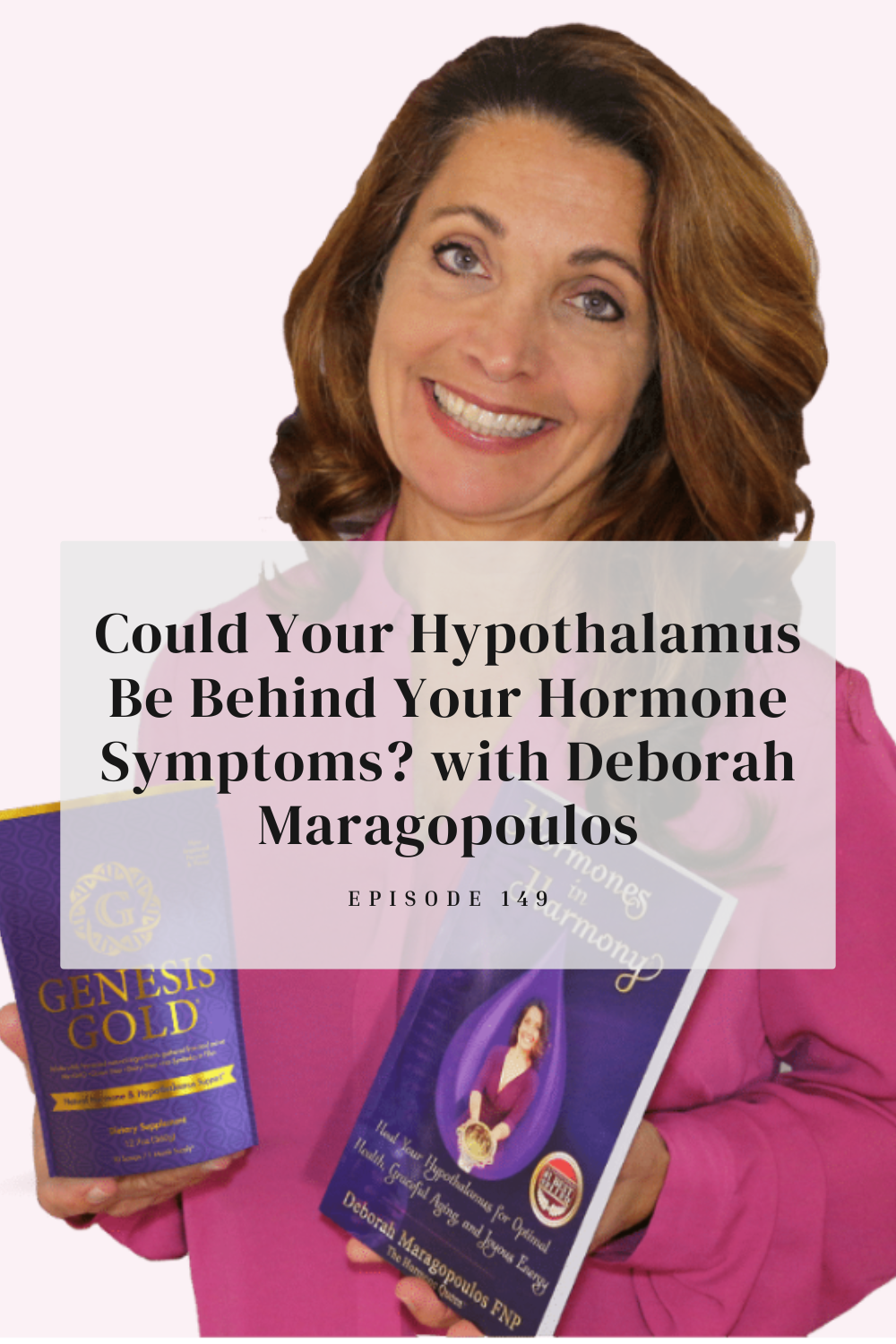
Deborah Maragopoulos MN FNP, an Intuitive Integrative Family Nurse Practitioner, bridges the science of medicine with the art of healing. Known as the Hormone Queen, Deborah specializes in functional neuro-immune-endocrinology with an expertise in optimizing hypothalamus function. Deborah is the author of Menopause Action Plan and Hormones in Harmony. Through her extensive clinical research and two decades of collecting empirical data, Deborah developed a unique holistic health care model that blends naturopathic and allopathic therapies to address the upstream cause of chronic illness and imbalance.
Save your seat inside The Confident Mama Masterclass → Join the Workshop here
Use my link for Needed & claim 20% off your first month → Shop Needed Supplements (enter code: mama20)
Apply for my coaching program and get access to HTMA testing here → Apply Today
Connect with Deborah:
→ On Instagram: https://www.instagram.com/deborahmaragopoulosfnp/
→ On YouTube: https://youtube.com/@deborahmaragopoulosfnp
Explore Deborah's products and explore her website: https://genesisgold.com
Download the FREE Hypothalamus Reset Bundle: https://thehormonequeen.com/mama
Brooke Harmer: All right, let me get one yon out of the way. Okay, and here we go. Hey Deborah, thanks so much for joining us today. We're excited to have you here.
Deborah Maragopoulos: Thank you for having me,
Brooke Harmer: I when I heard about the topic for today,
Deborah Maragopoulos: Brooke.
Brooke Harmer: I was like,"Oh my gosh, I can't believe we haven't talked about this yet." So, I'm so grateful that you're here. um because I would go as far as to say that most women like probably don't know much about what we're going to talk about today, but it plays such a pivotal role in so many different areas of our health. And here at the well-nourished mama on my podcast in my community, we always talk about finding the root cause and going as far back as you can go. And I really feel like talking about this is going to help us kind of understand how to navigate root cause care and understanding relationships of different things in our body and how they all come together. So I'm excited to chat.
Brooke Harmer: But before we dive into today's topic, can you just tell us a little bit about yourself, how you got started, and how you became so passionate about the brain and the endocrine system?
Deborah Maragopoulos: Thank you. Thank you so much. So, Brooke, I actually began as a nurse um just freshly graduated out of out of nursing school maybe about a year. I had a premature baby. My baby was very premature. I had what was help syndrome back in the day. It wasn't called that then. severe toxmia, traumatic delivery, premature baby who was born with ambiguous genitalia. And I had to make the decision at the age of 23 years old whether to raise the child as a female or a male based on what the pediatric endocrinologists were saying. It was easier to make a hole than a pole. I went with my dreams and my intuition, kept the baby uh according to their chromosomes and allowed them to be whoever they wanted to be, knowing that my intuition only, not my scientific background, was that that baby was exposed to both male male hormones and female hormones.
Deborah Maragopoulos: We don't know what its personality perspective, what's happening in its brain. So, let's see how it turns out. Um, come come to find out, you know, 20 years later, that was the correct decision. But back in 1984, nobody did anything like that. This was the first child that was raised by chromosomes and not by genital appearance in
Brooke Harmer: Wow.
Deborah Maragopoulos: America.
Brooke Harmer: What a conversation to be having in 2026.
Deborah Maragopoulos: So that I
Brooke Harmer: Like that seems like you're just like,"Oh yeah, like we just kind of like I don't know,
Deborah Maragopoulos: know.
Brooke Harmer: throw these ideas around now." But like what a conversation to have in 2026 knowing that this was happening in the8s. That is
Deborah Maragopoulos: Yeah, it was it was really incredible.
Brooke Harmer: incredible.
Deborah Maragopoulos: I thought I was going to go into like the pediatric aspect of nursing. I knew I wanted to be a nurse practitioner, but back then you had to get a couple years experience before you even go to grad school.
Deborah Maragopoulos: So, I put it off until the baby was about a year old and then went back to grad school and became a nurse practitioner and and then really focused on the endocrine system and focused on I was family practice so family nurse practitioner saw you know babies men women older people everybody then I went into women's health for a while and then in 1997 I started my integrative practice and I did that because I wasn't able to provide the kind of care I wanted to in conventional medicine I couldn't spend the time with people I couldn't really spend the time I really needed to to educate them and to really be a great advocate for them. So they left empowered. There was like so little time. We were so rushed. I saw like 28 patients a day. It was crazy. So I slowed down and I told the universe, I want to learn everything possible about the neuroimmune endocrine system. So nervous system, the immune system, and all your hormones. And um the universe complied and sent me the sickest people I could possibly imagine.
Deborah Maragopoulos: Again, men, women, and children. And I felt like while I was giving them more integrative options for treatment rather than conventional medicine, I was still giving them a lot of stuff. And if I could only figure out what was the root cause of all their problems, then I could possibly actually address that. And again, I meditated about it and this magazine shows up in my office and it has a fat white mouse and a little skinny white mouse on it. And I read the article and they had sacrificed the mice. I saw that the fat white mouse had many of the symptoms that my patients had. Anxious, couldn't sleep, were no longer reproductively viable. They had metabolic disorder, insulin resistance, adrenals weren't functioning, thyroid wasn't functioning, signs of autoimmunity. And when they sacrificed it, the those mice were not producing a hormone that is produced by the hypothalammus called pro-opio melanoortin. And that was my bingo moment. It was the hypothalammus I should be focusing on. So I switched my whole practice to hypothamic focus and then had to do a lot of research to figure out how do I assess it, how do I treat it and how do I provide foundational support for people so they can be have functioning optimally functioning hypothalamuses for the rest of their life.
Brooke Harmer: Wow.
Deborah Maragopoulos: That's a
Brooke Harmer: Wow.
Deborah Maragopoulos: lot.
Brooke Harmer: What a story. That is crazy. Okay. So, you pivoted to a hypothalamus and you're like,"Okay, this is what I'm going to do and I'm going to figure out how to do it along the way." So, in these last 15, 20 years, what have you seen? What's come of that? What has it been like making that pivot and having such a niche like that?
Deborah Maragopoulos: Before I answer that question, can I just tell all the mamas out there what the hypothalammus is so they can get a picture in their mind?
Brooke Harmer: Sure.
Deborah Maragopoulos: Okay. So the hypothalammus is a small gland right in the middle of the brain sitting on top of the brain stem. It's about the size of an almond in a shell. So if you put your finger like right between your eyebrows and go straight in, it's right there. It's right above the pituitary gland. And it's the master gland. I like to think of it as the maestro of your symphony of all your hormones, your neurotransmitters, your immune factors.
Deborah Maragopoulos: It talks directly to your gut. It controls your circadian rhythms. It controls your weight set point, your temperature regulation, reproduction, the stress response. It also is the controller of your memory, your cognition, your learning ability. There isn't much it doesn't control. We now know it also controls aging and it is actually core in autoimmunity because it controls the whole the way the um the white blood cells particularly the tea cells are programmed by the thymus. So there's so many things it controls. In my practice, what I've seen over the last, you know, 26 years or so since I really started diving into the hypothalammus and treating it is that much of what I was treating before with a lot of conventional medicine, let's say my infertility patients, I was doing intrauterine insemination, sending them for IVF. I don't have to do that anymore. I created a neutrautical that addressed the hypothalammus. it actually fed the hypothalammus and now they just get pregnant with that kind of support. Um, I treat, you know, adrenal fatigue, women who have, you know, they're fatigued during the day, they wake up tired, their thyroid's not functioning normally, they may have Hashimoto's or another autoimmune condition like rheumatoid arthritis or vitiligo.
Deborah Maragopoulos: Um, they have gut imbalances like irritable bowel syndrome. Their micrllora is off. They have chronic infections with either SIBO, small small intestinal bacterial overgrowth or they'll have like a candida overgrowth. It's constant what what it is. It's constant miscommunication in their system between the hypothalammus which is regulating everything and all the lower organs that is causing this chaos, this constant inflammation and they're just they're tired, they're stressed, they can't sleep, their periods are are a little wacky. It they don't have motivation. and they're having trouble remembering things and they get sick more often. They don't do that anymore if we start to optimize their hypothamic
Brooke Harmer: I love that you're bringing this up because one of the most common things that we hear as women,
Deborah Maragopoulos: function.
Brooke Harmer: especially during pregnancy and postpartum, whenever we have an issue, whenever there's something that's not quite right, and we're like,"Hey, is this normal? Is this not normal?" even if it's normal or not normal, our provider will look at us and say,"It's just your hormones." And that
Brooke Harmer: answer, that answer literally sends me into a rage because I want to sit there and say,"Okay, so tell me what hormones, tell me why, tell me where, tell me when." Like, it just seems so dismissive. And so by talking about the hypothalamus and how it influences the endocrine system, which mama, if you're listening, you're like,"What the heck is that?" The endocrine system is basically your hormonal system. So when we say hormones, when we talk about female hormones, when we talk about balancing hormones, when we say,"Oh,
Deborah Maragopoulos: Please.
Brooke Harmer: we're just it's just your hormones, whatever." What we really need to do is take a step back and say,"Well, what's influencing our hormones, what's controlling our hormones, where does the process start? And from what you're saying, it takes us back to the hypothalamus. Is that
Deborah Maragopoulos: Yep. It's upstream. It's not downstream. So, think about it,
Brooke Harmer: correct?
Deborah Maragopoulos: mamas. Just think about it as if you're in a big orchestra and everything sounds all goofy.
Deborah Maragopoulos: It just it's out of tune. So, instead of tuning up all the t the tulas and the string instruments and this that and the other thing, I'm actually giving the maestro the hypothalammus the proper sheet music because that's really what's what is wrong. So, it's about addressing those that upstream controller. It's like the operating systems in your computer. You know, most physicians, most providers are working on the software programs. They're working on individual hormones, individual systems, individual symptoms. I'm working with the operating systems. Okay? And that's the hypothalamus. And it is now in research. We know that it is controlling everything. Before it was like ignored. your your provider doesn't even talk about it because there's not a really good way to measure hypothalamic function unless you're a medical detective like I am where you can actually look at a bunch of things. You really I'm looking at narrative. I'm looking at your body type. I'm looking at a bunch of hormone levels not individually together.
Deborah Maragopoulos: I'm comparing them. I'm looking at the accesses. I may not be able to see the HPA axis, hypothamic pituitary adrenal axis, but I can look at the hypothalamus pituitary thyroid axis and I can see if there's miscommunication there. So, it's all it's looking at it all together to really get a picture, but there's also this, you know, mirage of symptoms that I see that I can almost always say something's going on with the hypothalammus. Something happened that actually started this dysregulation. And your hypothalammus' job is to help you survive. And right now is shunting all the resources to major organs of survival. So no wonder you're missing your periods. No wonder you're moody. No wonder you feel depressed. No wonder you have no energy. Those those are not necessarily survival systems. I got to get it to the heart. I got to get it to the brain. I got to get to the liver, the kidney. That's where the hypothalammus is focusing on.
Brooke Harmer: Okay. Now, I'm so glad that you said something because I wanted to pick your brain. I would love to learn more about the HPA axis. Um, and then there's also like a couple other ones like you mentioned the HPT. Um, okay, that actually might be like a really long-winded question. I was about to add more to that. Let's start with HPA because I think that's the one that out of all the ones that's probably one that the mamas are most familiar with. So talk to me about the HPA axis AXIS and what even that is and how it influences our overall health.
Deborah Maragopoulos: So the HPA axis stands for hypothalammus, pituitary, adrenal access. All the axes of the hypothalamus are negative feedback systems, which basically means that if the lower endocrine organ, in this case, the adrenal glands, are not producing enough cortisol, the hypothalammus receives that information via the blood. It reads the cortisol and tells the pituitary gland to produce its stimulating hormone, which is called act, to tell the adrenals to produce more.
Deborah Maragopoulos: or vice versa, too much cortisol, it lowers corticore releasing hormone which then shuts the pituitary down. So it's not stimulating the adrenal gland. So it's this negative feedback system which means the hypothalamus has sensors. It has receptor sites for every hormone, every neurotransmitter, cytoin that you produce so that it's constantly reading all this information. Now we think of think of the adrenals as just cortisol, but it's more than that. The adrenal glands are pretty complicated. They produce a hormone called adrenaline and that's actually stimulated by your sympathetic nervous system also controlled by the hypothalammus. The hypothalammus controls your autonomic nervous system. The sympathetic branches get up and go. We got to get out of here. The parasympathetic branches let's calm down. Slow down. Calm down. When your hypothalammus receives information from the outside environment, which it does because it gets four out of five of your senses. So, it knows what you're seeing, what you're hearing, what you're tasting, and what you're feeling. The sense of smell is a little bit different.
Deborah Maragopoulos: Okay. What will happen is it will then be alerted to what's going on in the outside environment. It's also alerted to what's going on in your inside environment. Do you have enough glucose? Are your electrolytes in balance? Are you are you exposed to a toxin or a virus, some kind of a pathogen? So it's receiving all this information and this is all in nanoseconds and it is actually telling the adrenal glands okay we need adrenaline now we need to get out of here and that means heart rate up blood pressure up and I can run away from the danger or I can fight the danger cortisol is produced secondarily once that adrenaline is produced then the hypothalamus tells the adrenal glands to I mean the pituitary to produce act to tell the adrenal glands we need some cortisol cortisol's job is to release stored sugar to fuel the fight or Right? That's its main job. When it's done doing that, it it gets converted into cortisone, which has an anti-inflammatory effect. And then it should just kind of fade away.
Deborah Maragopoulos: We shouldn't need it anymore unless your stress is constant. And then it's on all the time. Now, what happens you and mamas, you've probably had have done this before. You've used hydrocortisone on like bug bites or on a rash and you've probably been told or you should have been told not to not to let it stay on your fingertips because it's going to thin out the skin. Cortisone thins things out. It actually breaks down tissues. So when you have cortisol produced all the time, things are breaking down. Gut lining, vessel lining, neurons, skin, everything's starting to break down somewhat. bones, muscles. So, high stress with lots of cortisol for a long period of time is incredibly damaging.
Brooke Harmer: I love that explanation.
Deborah Maragopoulos: And that's I'm glad you I'm
Brooke Harmer: Oh my gosh, you explained that so well.
Deborah Maragopoulos: glad you understand. I hope all the mamas can understand that
Brooke Harmer: I know. My brain,
Deborah Maragopoulos: too.
Brooke Harmer: my ADHD brain is like moving so fast right now, just like gobbling everything up and I'm like,
Deborah Maragopoulos: I could see it.
Brooke Harmer: "Oh, my wheels are spinning. This is great." No, I love the connection between the like the hydrocortisone cream and then internally applying that same principle. I think that like that for me was really fascinating being like,
Deborah Maragopoulos: Yes.
Brooke Harmer: "Oh yeah, like that makes
Deborah Maragopoulos: Well, you know,
Brooke Harmer: sense.
Deborah Maragopoulos: there's actually some really good studies that show that chronic stress or one big trauma that caused a stress can cause long-term illnesses later like big major illnesses like metabolic disorders where you have cardiovascular disease, high blood pressure, high sugar, insulin resistance, high cholesterol, or even cancers. Okay? And why would that be? Because this this hormone which you is absolutely vital to your survival, cortisol too much is not a good thing. It can be damaging. So over time it can be damaging. Now a lot of people have heard of adrenal fatigue. Like now my adrenals aren't functioning at all. Well that makes sense. If you take a muscle and you keep flexing and flexing and flexing and flexing eventually it's going to get fatigued.
Deborah Maragopoulos: Same with the adrenal glands. So when you're constantly stressed it's constantly having to put out you know the hypothalammus was not was designed to help you survive. So when it's constantly getting the message that cortisol is up all the time, you're because you're constantly under stress, it's eventually going to shut down its receptor sites, literally put its little fingers in its little earplugs and ear holes and say,"I don't hear you anymore. You've been crying wolf. You are not being chased by a tiger. Okay? We are not in mortal danger. I'm going to stop listening to that message because you're distracting me from everything else I need to do. And then the adrenals don't get stimulated. And then you get adrenal fatigue. Now you're not producing enough cortisol. It's not that the adrenals can't. It's just that the communication network has been disrupted by too much information. One way to think about receptor sight sensitivity is if you've ever been cooking in the kitchens, mama, and your your spouse or your partner walks in and says,"Hi, are you burning the oven? I mean,
Deborah Maragopoulos: the onions and you're like, I didn't smell that at all." Well, because your receptor sites in your and your alactory senses was slowly receiving the information. So, you were getting used to it. You became insensitive to it. It was new to your partner. Okay? So when the cortisol first surges, it's new and fresh and exciting and oh my gosh, we got to get out of here. But over time, your body starts ignoring it. At least the hypothalamus does. The rest of the body is getting the the dredges of cortisone just breaking down the
Brooke Harmer: Okay. Yes. So,
Deborah Maragopoulos: tissues.
Brooke Harmer: we've got the HPA access and then there's like a couple other branches that we could take. Where does our thyroid and our gut and our reproductive system fit in with the hypothalamic pituitary da da da chain?
Deborah Maragopoulos: the whole the whole thing. Okay. So, the hypothalammus actually controls your reproductive system through a through a separate network. Then it controls the thyroid and the adrenals and your glucose metabolism.
Deborah Maragopoulos: It controls your gut through the veagal nerve. So, it's different axises. So, there is there's actual axis for the hypothalamus, pituitary, thyroid. It follows the same big master hormone that proopio melanoortin the one I told you about that I discovered the hypothalammus that gets broken down into cortical releasing factor which controls the adrenals thyroid releasing factor which controls the thyroid glucose releasing factor which controls the pancreatic production of insulin and also the liver's ability to store glycogen melanocyt stimulating hormone that controls your dayight cycles and the rest becomes endorphins. So that one big hormone when it's off in the hypothalammus con contributes to a lot of metabolic and circadian diseases, insomnia, anxiety, adrenal issues, thyroid issues, glucose issues, diabetes. Your gut is actually connected to the hypothalamus via the veagal nerve. That's the big parasympathetic nerve that talks directly to gut and the microbiome talk directly back to
Brooke Harmer: Right.
Deborah Maragopoulos: the hypothalammus telling the hypothalammus what what it needs. So if your microbiome's off, you've got a bunch of pathogens in there. It's talking too.
Deborah Maragopoulos: So the gangs are asking for more resources when it should be the good guys. So there's that communication going on. The hypothalamus also talks to your gut directly through end the endocrine system as well. It actually produces hormones and talks to the gut related to digestion and
Brooke Harmer: Okay. So, yes,
Deborah Maragopoulos: motility.
Brooke Harmer: everything comes back to the hypothalamus and then there's these little branches where it starts to pair off and say,"Okay, I'm going to the thyroid over here and I'm going to the liver over here and the gut over here." What about our reproductive hormones like FSH and LH? Are those related to the
Deborah Maragopoulos: Yes, absolutely. So your hypothalammus produces something called G&RH,
Brooke Harmer: hypothalamus?
Deborah Maragopoulos: the gonadotropen releasing hormone that stimulates your pituitary to produce FSH in response to how much estradiol your hypothalammus has perceived or LH in response to how much progesterone your hypothalamus has perceived. So your hypothalammus has receptor sites for all your hormones. So it knows how much estrogen and progesterone you have in your system.
Deborah Maragopoulos: So FSH is on the opposite side of the seessaw of um estrogen and LH is the opposite side of the seessaw of pro of progesterone. Okay. So there's this constant negative feedback system. And GN Rh is produced in in pulses.
Brooke Harmer: Okay.
Deborah Maragopoulos: So it's not like a steady stream. It's like pulses of this. It's the pulsatility. It's con kind of like waves of this hormone that actually keeps everything alive and vibrant and a reproductive woman producing just enough hormones to not only keep her uterus where it needs to be to potentially conceive and keep that pregnancy viable, but also her heart and her brain and all the parts of her body as juicy as possible so that she can be the best mama possible so she can feed that baby and take care of those children. She can remember everything. She can multitask. It's all for her survival for her, her children, the species. Okay? That's how important the hypothalamic, pituitary, ovarian access is. When you go through menopause, you start losing that.
Deborah Maragopoulos: You lose those pulses and everything starts fading. You've also run out of eggs, so you don't have any chance to make any more estradile or progesterone. And everything starts fading. You start seeing the chronic illnesses.
Brooke Harmer: Okay. Okay. So, now where does autoimmunity fit in here? Because I'm hearing all these different endocrine systems, the liver, the thyroid, the pancreas,
Deborah Maragopoulos: Great.
Brooke Harmer: the, you know, your ovaries, and like the reproductive system. Um, most autoimmune illnesses are tied to some major endocrine organ. So, where does the hypothalamus fit in with
Deborah Maragopoulos: So, the hypothalammus controls how your immune system functions.
Brooke Harmer: autoimmunity?
Deborah Maragopoulos: Okay? And how it does that is through a hormone called prolactin, which your mama should know about this hormone. Prolactin is the prolactation hormone.
Brooke Harmer: Mhm.
Deborah Maragopoulos: And we all make it, men, women, and children, but we make most of it at night. Now, you pregnant moms and lactating moms, you make a lot of it all the time.
Deborah Maragopoulos: And I'll tell you why you're feeling a little goofy during those times because of prolactin. But let me tell you what prolactin is supposed to do when you're not pregnant or lactating. So prolactin's job is to be nice and low during the day and high at night. It actually follows melatonin by 3 hours and you produce it in an eight hour window. Its job is to enasticize you and stimulate your thymus, which is a tiny little gland above the heart, which is the boot camp for your white blood cells to learn the difference between you and other. If it doesn't know the difference between you and other, it will attack you, which is what autoimmunity is. So with a proper prolactin production in the dark at night, you're going to see healthy tea cells coming out knowing the difference between you and other not attacking you. When prolactin production is off, and the only thing that turns it off is the hypothalammus waking up and producing dopamine. It turns it off in the morning and it should be nice and low during the day.
Deborah Maragopoulos: If it's up during the day, then what's going to happen is you're going to have some self- attack. Okay? So, what has that got to do with mamas in pregnancy? Why would prolactin be so high then? Well, we discovered the hormone because it promotes lactation. That's why it's called prolactin. But it's also high in pregnancy. It's high in pregnancy because one thing that the prolactin does during the day is it blocks your hormone receptor sites. So, if you have high prolactin during the daytime, you're not responding to estrogen, progesterone, cortisol, thyroxine, T3. You're not responding to the hormones because prolactin won't let it in. All my obese patients, all my autoimmune patients, all my patients with metabolic disorders have dissircian prolactin. It's not letting those hormones in.
Brooke Harmer: So,
Deborah Maragopoulos: Okay. Now,
Brooke Harmer: does that mean that it's being secreted at the wrong time or the wrong
Deborah Maragopoulos: that's wrong time
Brooke Harmer: amount?
Deborah Maragopoulos: and wrong amount. So, mostly it's the time. They're producing too much during the day and not enough at night.
Brooke Harmer: Okay.
Deborah Maragopoulos: Sometimes the wrong amount because if they're producing way too much, it could be a pituitary tumor. Okay? In pregnancy, it's supposed to be high because we need to block mama's hormone receptors. Otherwise, the high estrogen and progesterone of pregnancy would grow things we don't want. Okay? So, it's protecting your skin. It's protecting everything else. In lactation, it's actually preparing the breast for lactating and it's also stimulating the let down. Okay? So, it's part of the whole process and it's also to put mama in a neutral hormone state. So when the prolactin's high, it's hard to respond to your own hormones and it usually will block your fertility, which is it's kind of like natural birth control between babies when you're lactating because of that high prolactin level. Infertile patients oftentimes will have a distircadian or high prolactin level that we need to get down in order for them to ovulate. So prolactin has its purposes for both reproduction,
Brooke Harmer: Okay.
Deborah Maragopoulos: but also for the rest of us that are not reproducing and not lactating to actually run our immune system.
Deborah Maragopoulos: It helps you as a mama, whether you're pregnant or lactating, make the proper antibodies so you can tell your fetus and your newborn how to fight off the world of germs.
Brooke Harmer: And also so we don't attack our baby, right? Because like the baby is separate from us. We're connected, but we're separate. And we don't want our body to hurt the baby either.
Deborah Maragopoulos: So you don't recognize the recognize the baby which is different than you. The baby's basically foreign.
Brooke Harmer: Yeah.
Deborah Maragopoulos: It's not your it's half your DNA that the other half we don't you don't recognize. So it helps it blocks that whole aspect which is exactly what we want. But the kind of funky things that you're feeling after after you have a baby,
Brooke Harmer: Yes.
Deborah Maragopoulos: you just don't feel yourself. You're tired all the time. you feel like you're not reacting at the same rate that you would have. You know, you just don't have that reaction time. That is prolactin. Prolactin when it's high, it makes you kind of feel like you're sleepwalking.
Deborah Maragopoulos: You're not you're not quite there. That's okay because mamas in the beginning when they're first nursing those babies need to kind of be in a cave and hibernating. We don't let them. We make them go back to work and do all kinds of stuff. But nature has set it up so we're like in the den with our babies just kind of hibernating and and bonding and producing milk and we don't have to deal with all that out there. Somebody else is taking care of that. But that's why if you, you know, try to do too much, you don't have help with the other children, you've gone back to work right away, you do feel like you're not at your prime performance because you're not. Prolactin's blocking your ability to do that.
Brooke Harmer: Okay. So, my my wheels started spinning. So,
Deborah Maragopoulos: I can
Brooke Harmer: let's let's bring this I'm trying so hard I'm trying so hard not to derail and like go on all these tangents.
Deborah Maragopoulos: see.
Brooke Harmer: Okay.
Brooke Harmer: I want to bring this back to the autoimmunity aspect and this really special time during pregnancy and postpartum/lactation where prolactin is supposed to be high. That's how it's supposed to be. It's not a bad thing.
Deborah Maragopoulos: Yes.
Brooke Harmer: However, knowing that prolactin is high, what is that doing to our immune system and how does that change our risk of autoimmunity and having dysfunction as a result of this unique phase of life that we're in?
Deborah Maragopoulos: So, so the assumption that you're that I can hear you're making is that because it's high all all pregnant and lactating women are more prone to becoming autoimmune. They have like a window of opportunity of vulnerability.
Brooke Harmer: I call it like a trigger state,
Deborah Maragopoulos: Yes and no.
Brooke Harmer: right? Where it's not necessarily that like you will get sick.
Deborah Maragopoulos: Maybe.
Brooke Harmer: It's more like it's this perfect storm where if you're not supported enough, like if you know, if nutrition isn't there, if lifestyle, if circadian rhythm, if nervous system isn't there, pregnancy and lactation becomes that trigger state that spills the bucket and now we've got this cascade.
Brooke Harmer: That's kind of what I'm getting at.
Deborah Maragopoulos: Yes.
Brooke Harmer: I don't want it to be like A equals B. More like Yeah, you get what I'm saying? So,
Deborah Maragopoulos: Yes.
Brooke Harmer: continue.
Deborah Maragopoulos: It is. It is. It is a potential trigger. And it's a potential trigger in the mama who she's not wellnourished. she hasn't and not just during the pregnancy and lactation,
Brooke Harmer: Yeah.
Deborah Maragopoulos: but she's had years of not being wellnourished, you know, and wasn't able to cut with that nourishment level. So, she was feeding off her own resources, her own muscles and her own bones and her own fatty acids, and so she's not as well nourished. Perhaps she has some major trauma in her past that creates an HPA access that's overfiring all the time so that the hyperolactin level is seen as a tiger chasing her. It's a danger signal. So that's so she's kind of triggered for oh my gosh, you know, I call it the Chihuahua um mentality versus the blood hound.
Deborah Maragopoulos: You know, she's just she's a little trigger happy there. There's a little triggering going on. Her guts out of balance, so she doesn't have the right microbiome that's healthy for her. And so that's constantly throwing out inflammatory markers that's telling the hypothalammus that there's a fire everywhere. She maybe has low thyroid function. Maybe she um wasn't producing enough progesterone in the pregnancy to like c actually help the parasympathetic nervous system make enough GABA to keep the nervous system calm down. And she just she has she's always on that sympathetic, you know, run away from danger kind of system. So there's a lot of things that can go into that. There's a lot of lifestyle behaviors and and again neutruticals that we can actually help mamas with so that they can be as healthy as possible so they won't get a triggered effect. If they have a genetic propensity towards autoimmunity, it may take one or more of those triggers, sometimes only one, to actually create that perfect storm.
Brooke Harmer: Yeah, for me I was diagnosed with Hashimoto's after my third baby.
Deborah Maragopoulos: Yeah.
Brooke Harmer: So it wasn't a problem after my first. It could have been maybe the beginning after my second, but I got pregnant with my third at 7 months postpartum. So it was just kind of weird. Anyway, so I officially got my diagnosis at like 3 or 4 months postpartum with my third baby. Um, and at the time I was like, I literally teach nutrition and lifestyle for moms.
Deborah Maragopoulos: Mhm.
Brooke Harmer: Why am I the sick one? This feels like it's coming out of left field. And, you know, since then, I've done a lot of work and a lot of research, and it wasn't out of left field. I just hadn't seen, you know, all the things adding up to where I finally got diagnosed. But um yeah, it's I it makes me so frustrated when I hear people say,"Oh, well,
Deborah Maragopoulos: Oops.
Brooke Harmer: I have this because I got pregnant." Or, um, you know, I, and this could be a sensitive subject, so please don't hate me for saying this, but I've heard some women say,"Well, I was depressed because of breastfeeding." And to that,
Brooke Harmer: my response is,"It's not the thing itself. It's not pregnancy itself. It's not lactation itself. It's not even prolactin itself or whatever hormone we want to focus on. From what I understand, it's more the lack of support in one or more areas combined with whatever event is occurring.
Deborah Maragopoulos: Exactly.
Brooke Harmer: And the event is more of a trigger rather than a root cause. And so that's why I'm so glad we're talking to you because I don't want moms to walk away thinking that stupid prolactin. Oh my gosh, no wonder. That's not what we're saying.
Deborah Maragopoulos: No prolactic.
Brooke Harmer: We're saying it's it's this it's this combination of everything that when you put the natural biology of how prolactin changes on top of everything else, that's when we start to see the dysfunction come. But it's not prolactin's fault. It's not the hypothalamus's fault. It's all these other things that we actually have a lot more control over than we realize.
Deborah Maragopoulos: But wait a second. I want to tell you, mamas, it's not your fault.
Deborah Maragopoulos: Okay? It's not your fault because most providers don't even look at the hypothalammus. Most providers aren't going to dig up your triggers. Look how much research Brooke has had to do to figure out her own Hashimoto's. Most are not going to go to that length to figure out what actually triggered you and help you get back to that point and start to correct everything. So, the way I look at it is your hypothalammus is trying to save you. Wasn't getting everything it needed. There was a lot of stress going on. Pregnancy was added on top of it. Something had to give. And for you, Brooke, it was an autoimmune condition. for another woman it you know maybe um diabetes it would something has to get for me it was help syndrome and it was all it was st it was definitely stress related the year before I got pregnant I don't know if you ever taken one of those like depression scales of all the stressors you could possibly have and then you add it up and I had so many that I should have committed suicide that's how high they were I had deaths in the family major changes so there was there was a reason for all of this
Brooke Harmer: one.
Deborah Maragopoulos: happening Um, but that's the way my body responded to it. I may not get autoimmune condition.
Brooke Harmer: Mhm.
Deborah Maragopoulos: Mine responded in a major inflammatory response. Okay? So, we all respond differently. We all have our killilles healed per se of how we're going to respond. But the upstream operator of all of this is your hypothalammus. So if it is well supported all throughout your life throughout your pregnancies throughout your lactation you are less likely to have that hypothalamic dysregulation that leads to autoimmunity. systemic inflammation, endocrine imbalances, neurological challenges, mood disorders, etc. It is it is truly in the hypothalammus that is the control and and you can control that and there are lifestyle pieces there that you can change. Although I got to say that a lot of my patients who I've counseledled for years with lifestyle changes like dietary activity, sleep, they don't make the changes stick until we neutrutically support their hypothalammus. It's almost like they're fighting it and they can't get to why they're actually sabotaging themselves and they always admit it.
Deborah Maragopoulos: They come back, I didn't follow all this. Like, okay, what's getting in the way? And then there's kind of a realization that occurs, which is interesting because the hypothalammus controls the portal between your conscious and subconscious mind. So, oftentimes it'll come as a thought or in a dream that, oh my gosh, I'm act this is why I'm self-sabotaging. I can give you an example of that.
Brooke Harmer: Yes,
Deborah Maragopoulos: of a patient had a an interesting So,
Brooke Harmer: please.
Deborah Maragopoulos: this this was a middle-aged woman and she'd been fighting her weight for years and we worked on everything, diet, activity, you you named it. It wasn't until she started taking the hypothalamic support that she finally realized what was happening. Her weight was just yo-yoing constantly and she said,"You know what? I get it now." She'd been about three months on the sport and she said,"I am sabotaging myself and it's because when I get thin, other men look at me and I'm afraid I'm going to be unfaithful. And so I gained the weight back.
Deborah Maragopoulos: So we got her counseling, both couples and individual, and they worked out their issues. She worked out her self-esteem issues, and then she was able to keep the weight off.
Brooke Harmer: Interesting. Okay. So,
Deborah Maragopoulos: The mind body is pretty big.
Brooke Harmer: say that again.
Deborah Maragopoulos: The mind body um connection is very big, very influential.
Brooke Harmer: Yeah. That's why that's why the the order of healing is something that I teach. And that's why in the order of healing, the first step is mindset. It's not anything tangible that you can like run a test for or look at it on a lab
Deborah Maragopoulos: Mhm.
Brooke Harmer: report. It starts with the mindset because your, you know, your thoughts become your words, your words become your actions. And we've all heard that saying. So, I love that you bring that up. Okay. I want to wrap up by talking about how we can actually support the hypothalamus. Can we actually do things nutritionally or with our lifestyle that support the hypothalamus or is it just kind of there and we just cross our fingers that it does its job
Deborah Maragopoulos: Yes, absolutely. So, I have five pillars of hypothalammus healing.
Brooke Harmer: properly
Deborah Maragopoulos: Mindset is one of them. Mindset's definitely one of them. Having a healing mindset, you know, the glass is half full versus the glass is half empty makes a big difference. Believing that what you're doing is going to help you. Again, when I offer neutrutical support to my patients who have a glass half empty mindset, they kind of shift over time. That's an interesting perspective where they start to see the beauty in life and start to see things that are working instead of, you know, bad bad talking themselves. Nutrition is a big piece. And I would say that the healthiest diet for the hypothalamus is the Mediterranean diet. Plant-based, adequate protein, healthy fats, not, you know, not too much alcohol, not too much coffee, organics, etc., but mainly plant-based. The hypothalamus needs a lot of phytonutrients in order to do its job properly. But it's more important when you eat to the hypothalammus than what you eat.
Deborah Maragopoulos: What is very important, but when is very important, too. You need to start off eating breakfast. Your hypothalammus needs to be fueled right away. The body needs to be fueled right away. You need to stop eating 3 to four hours before you go to bed because your hypothalammus, if you're digesting, can't go into nocturnal mode. So it can help you clean house, get your immune system functioning and do its job properly. That means your immune system functions during the day instead and it's attacking you instead of other. So eating earlier makes a big difference. Trying to get most of your calories in during the daytime. The same with sleep, trying to get good sleep. It's hard when you're a mom. I know it is. Um, play around with the light. Get off your screens after dusk. If you have to be on a screen, wear, you know, blue blocking glasses because that will affect your ability to make melatonin. The hypothalamus perceives it and says,"Well, the sun still must be up. We got to stay awake here." And it won't trigger the pineal gland to make the melatonin.
Deborah Maragopoulos: And sleep in the complete dark. Your room also needs to be pretty cold, like 60 to 67 degrees, because that's the hypothalammus needs that lower degrees to order to for the best melatonin production and also to go into nocturnal mode. It does help though to have a cover over you, even just a sheet, because there's something about your body feeling protected that you'll go into that deeper sleep. We want you in the deep sleep. Please do not worry, mamas. If you go into deep sleep, you will be able to wake up. Your sense of smell and hearing are acutely upgraded being a mom to your babies. Okay? And honestly, I've noticed this. I'm a nana now. So, when I have my granddaughters sleeping over at my house, I am on mama mode. I I can go deep to sleep. I sleep great, but I'm on that mode. I can tell before they they sit up in bed that they need me. I can feel them.
Deborah Maragopoulos: Okay? And you have that that intuition, that sense. You can turn it on and off. You will have it on. Rest. Go to sleep. You need your rest. It's super important. Activity. If you're sitting around all the time and not moving your body, your hypothalammus puts you into kind of hibernation mode and slows everything down. So, you need to get up and move around and do it. Doesn't have to be super intense exercise. And definitely do not exercise intensely late because that's a cortisol spike and that'll that actually prevents your melatonin from rising at night. So you don't want to like try to you know do an intense exercise after dark. And then the last thing is nutritutical support. Your hypothalammus needs specific sets of amino acids to do its job properly. I have found that um seed vegetation is incredibly nutrientrich for the hypothalammus. Um phytonutrients as well as omega-3 pufas polyunsaturated fatty acids the hypothalammus needs as well.
Deborah Maragopoulos: I wasn't able to find it for my patients in one single thing. So, I ended up creating it,
Brooke Harmer: And what's that
Deborah Maragopoulos: the uh the new, it's called Genesis Gold, and I created it because I couldn't find it.
Brooke Harmer: called?
Deborah Maragopoulos: And also because I wanted one thing that they could take that would actually help to heal them instead of lots of bottles of stuff. And it it's it's worked out that way that it's been able to replace multiple types of supplementation. And then I've just started playing around with it over the last you know two and a half decades on what else could we could we treat with hypothalamic support and get back into balance. So lots of autoimmune conditions, all kinds of endocrine conditions, um neurode divergent adults and children, um even dementia it based because it's all hypothalamic driven are those particular issues. You're going to see a a change in the in the way the body is optimizing its functioning at the biochemical level when the hypothalammus is doing its job properly.
Brooke Harmer: Okay.
Brooke Harmer: And I I want to ask with the Genesis Gold, is this is this a supplement that we would take for maybe 6 months or something like during a protocol while we're doing all of that other hard work to work on whatever we need to work on and then we don't need it anymore? or is this kind of more like a a a multivitamin for the hypothalamus where it would be like a daily maintenance ongoing? How do you use
Deborah Maragopoulos: That's a really good question. So, I use it acutely for my patients who are hypothamically challenged.
Brooke Harmer: it?
Deborah Maragopoulos: They're they need some support. And then I will I will lower the dose and let them use it for maintenance. I've had patients like myself who've been on it for more than 20 years. Um I'm 65 years old. My biological age is 46. And I've seen in my patients who've used it for a long period of time, 10, 15 years, their biological age is much much younger. And that's because the hypothalammus controls aging.
Deborah Maragopoulos: Um, and like I had mentioned before we started, um, I used to do a lot of infertility work. I don't need to do that level of work with my patients anymore. Um, now they're customers. They take the product and usually can get pregnant within 3 to six months unless they have a mechanical issue like blocked tubes. Most time it is a hypothalamic pituitary ovarian access issue. I also recommend that their partners take it because you know a lot of men aren't producing the right types of hormones either and they've got a lot of inflammation going on. Their their spermatzoa needs like a six week head start. Your om needs about a three-month head start. It's about a few months before you get pregnant, both on it, so you're as healthy as possible, especially to get your gut healthy because you're going to pass that on to the to that baby. And they'll take it through pregnancy and in lactation. The women that I've actually had like the befores and after started with me way before I even got into the hypothalammus and I had to help them with infertility and then they followed me into my integrative practice and I was able to give them Genesis Gold to support them.
Deborah Maragopoulos: Totally different pregnancies. totally different outcomes. One in particular insecination for both. Okay, we've had to do an insemination, but she had um you preeacclampsia with the first one. She had diabetes with the first one. That first child has a learning disability. Second child, no problems at all in the pregnancy and that child has no learning disability. I think she was just more neutrutically supported. She was healthier getting into the pregnancy and this was the second
Brooke Harmer: I love that. Okay, so how how do we go about getting help? How do we know if we need help? How do we connect with you if this is something we want to explore and learn more
Deborah Maragopoulos: So, you can find me at genesisgold.com.
Brooke Harmer: about?
Deborah Maragopoulos: I also have a YouTube channel under my full name, Deborah Maragopoulos FNP, but that's hard to spell. And I did create a um a gift for your for your listeners, for the mamas out there, so that they could actually learn a little bit more about how their bodies work.
Deborah Maragopoulos: It is called my hypothalammus reset bundle and it's my hypothalammus handbook as an ebook, but I also took you through the case studies as video tours. So I basically created a video a training video that's not very long but it's just so I can present like what's going on with these people and all their complicated issues and how it's related to the hypothalammus so you can start seeing the patterns in the book are the protocols exactly what I gave them how long it took to work what their lab levels were before and after. Um but it's a it's a really good way to learn more about your hypothalammus and you know figure out like does this pattern seem like me? So, and and you may see, you know, children's patterns, spouse's parent patterns, p you know, your grandparents or mother and father's patterns as well because I I cover a range of ages and genders as well in the book. They can you can find that at the hormone
Brooke Harmer: Awesome.
Deborah Maragopoulos: queen.com/mama.
Brooke Harmer: Okay, we'll make sure to link that in the show notes.
Brooke Harmer: Thank you so much for joining us today, Deborah. It was so enlightening to finally talk about the hypothalamus and how it's all connected. We really appreciate your time.
Deborah Maragopoulos: Thank you so much for having me,
Brooke Harmer: We have one more question for you. It's a question I ask all my guests,
Deborah Maragopoulos: Brooke.
Brooke Harmer: but it doesn't have to be related to our conversation today. We would love to know what is a non-negotiable to you to living a well-nourished
Deborah Maragopoulos: Non-negotiable for me.
Brooke Harmer: life.
Deborah Maragopoulos: I won't give up my sleep. Sleep is non-negotiable because I know that that's really core to my hypothalammus health. So, I make sure that I get my seven to nine hours every
Brooke Harmer: I love that.
Deborah Maragopoulos: night.
Brooke Harmer: I am excited for a phase of life where I can have that uninterrupted
Deborah Maragopoulos: You will. You will. When I was your age, I was running on three to five hours of sleep at night.
Brooke Harmer: consistently.
Deborah Maragopoulos: had some ambulance and you know which is sleepwalking it it wasn't good and major endocrine issues because of all of that.
Deborah Maragopoulos: Um, so you will eventually get there and if you support yourself before that you maybe you don't have to to suffer so much with the the sleep
Brooke Harmer: Yeah, it has been a lot of work. I'm doing okay.
Deborah Maragopoulos: deprivation.
Brooke Harmer: I think right now I am getting about seven to eight hours and I only have to pee twice during the night. So, it's not perfectly um through the night, but I would say getting up to pee is probably the smallest interruption you could have.
Deborah Maragopoulos: So,
Brooke Harmer: So,
Deborah Maragopoulos: one way you can see if you're like getting into that deep sleep, do you remember your dreams?
Brooke Harmer: Oh, yeah.
Deborah Maragopoulos: Okay,
Brooke Harmer: I'm a big dreamer.
Deborah Maragopoulos: that's good. That means you're making enough dopamine. The hypothalamus is making enough dopamine so you can recall
Brooke Harmer: Oh, good to know.
Deborah Maragopoulos: them.
Brooke Harmer: Okay, thank you for that. Well, again, Deborah, it was a pleasure to have you. Mamas, if you want to connect with Deborah or um check out Genesis Gold or just learn more about what we talked about today, please go look at the show notes. We'll have everything linked there. And then be sure to leave a rating and review so that Deborah and I know how much you appreciated our conversation today. All right, Deborah. Thanks for joining us, mamas. We'll see you in the next episode.
Deborah Maragopoulos: Thank you.
Brooke Harmer: Yay! That was amazing. Thank you so much,
Deborah Maragopoulos: It was a lot. And
This editable transcript was computer generated and might contain errors. People can also change the text after it was created.

Leave a review